
 facebook :
- Home
- Show Content
Grammar :Voice



Grammar :Voice
लेखकको बारेमा :
Name: Dev Prasad Pandit
Address:Khairahani-4, Chainpur, Chitwan
School: Jana Jiwan Secondary School,Khairahani-2, Chitwan
..............................................................
Voice
There are two types of voices: Active and Passive.
- Active Voice: Ram calls Rita.
- Passive Voice: Rita is called by Ram.
Active Voice
When the subject of a sentence is active or performs the verb’s action, then the sentence is called the sentence of active voice. Active sentences have a strong, direct, and clear tone. Here are some examples of active voice.
Examples of Active Voice:
- Mohan writes a letter.
- The boy played cricket.
- The dog has chased the cat.
All these three sentences have a basic active voice construction: subject, verb, and object. The subject Mohan performs the action described by write. The subject the boy performs the action described by Played. The subject the dog performs the action described by chased.
Passive Voice
When the subject of the action is passive or subject is acted on by the verb then the sentence is called the sentence of passive voice. The passive voice is always constructed with the combination form of to be plus the verb’s past participle (V3). Doing this usually generates a preposition as well. That sounds much more complicated than it is so passive voice is actually quite easy to detect. Generally, we can see be+V3 in passive voice.
Examples of Passive voice:
- A letter is written by Mohan.
- Cricket was played by the boy.
- The Rat has been chased by the dog.
The Rules for changing active voice into passive voice are as follows:
- The object of active sentence should be written at first as the subject in passive voice.
- Farmers grow rice. (Rice is object here)
- Rice is grown by farmers. (Rice is used as subject in passive voice)
- If there is an auxiliary verb in active voice, it should be written in passive voice. But the agreement must not be violated. It should be taken into consideration.
- My father has called me. (has is auxiliary verb here)
- I have been called by my father. (has is changed into have because of subject verb agreement)
- Be verb should be used in the form of main verb.
V1= is /am/ are
V2= was/were
V3= been
V4= being
V5= is/ am/ are
(to/aux.+) V1= (to/aux+) be
My father has called me. (called is in V3 form here)
I have been called by my father. (been is the V3 form of 'Be' verb which is inserterd before V3)
- Main verb should be changed into past participle (V3) form.
Play/plays/played/playing = played
Write/wrote/written/writing/writes= written
(Any form of main verb should be changed into V3 form in passive voice.)
- Farmers grow rice. (grow is main verb here)
- Rice is grown by farmers. (The main verb 'grow' is changed into V3 form i.e grown)
- If there are still remaining part of the sentences like adverb, another object, prepositional phrase and so on, they should be written after verb (But manner of adverb is written before main verb).
Active: He writes some words on the board.
Passive: Some words are written on the board by him.
Active: People give a warm welcome to the Prime Minister.
Passive: A warm welcome is given to the Prime Minister.
Active: Sabin speaks Hindi very well.
Passive: English is very well spoken by Sabin.
- Subject should be written at last with 'by'. If there are vague subjects like people, we, they, someone, somebody, everyone, everybody, anyone, anybody, no one, nobody, none etc., it is not necessary to write them with 'by' at last. (But 'not' must be added after auxiliary verb in those sentences containing no one, nobody and none as subject in active voice.)
Active: Ram killed a snake.
Passive: A snake was killed by Ram.
Active: Kamala paints the wall beautifully
Passive:The wall is beautifully painted by Kamala.
Active: Everyone is watching the game.
Passive:The game is watched.
Active:Someone has stolen my pen.
Passive:My pen has been stolen.
Active: Nobody heard a sound.
Passive: A sound was not heard.
Active: They are going to destroy the forest.
Passive: The forest is going to be destroyed.
Active: I remember somebody giving me a beautiful gift.
Passive: I remember being given a beautiful gift.
Different forms of verb Some examples
V1= Present (plural) go, play, eat, run, write
V2= Past went, played ate, ran, wrote
V3= Past participle gone, played, eaten, run, written
V4= Present participle going, playing,eating,running, writing
V5= Present (singular) goes, plays, eats, runs, writes
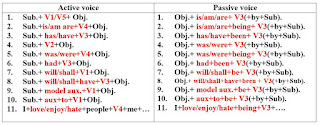
The passive form of interrogative (question) should be in interrogative (question) form.
Active: Are people destroying the jungle?
Passive: Is the jungle being destroyed?
Active:What is he writing?
Passive:What is being written by him?
Videos for testing the competency of students (voice)
नोट: अब यहीँ Chapter सँग सम्बन्धित Multiple question answer को मोडेलमा Video पनि राखिएको छ । हेर्नको लागि Play Video गर्नुहोला । थप ज्ञान हासिल गर्नुहोला ।

- Reviews (0)
Nothing Found...Leave a review